

AAC and access technology support for schools, with services available to early learning centres and education providers across Western Australia
The Access and Communication in Education (ACE) Service provides practical, school‑based support for education teams working with students who have complex communication and access needs.
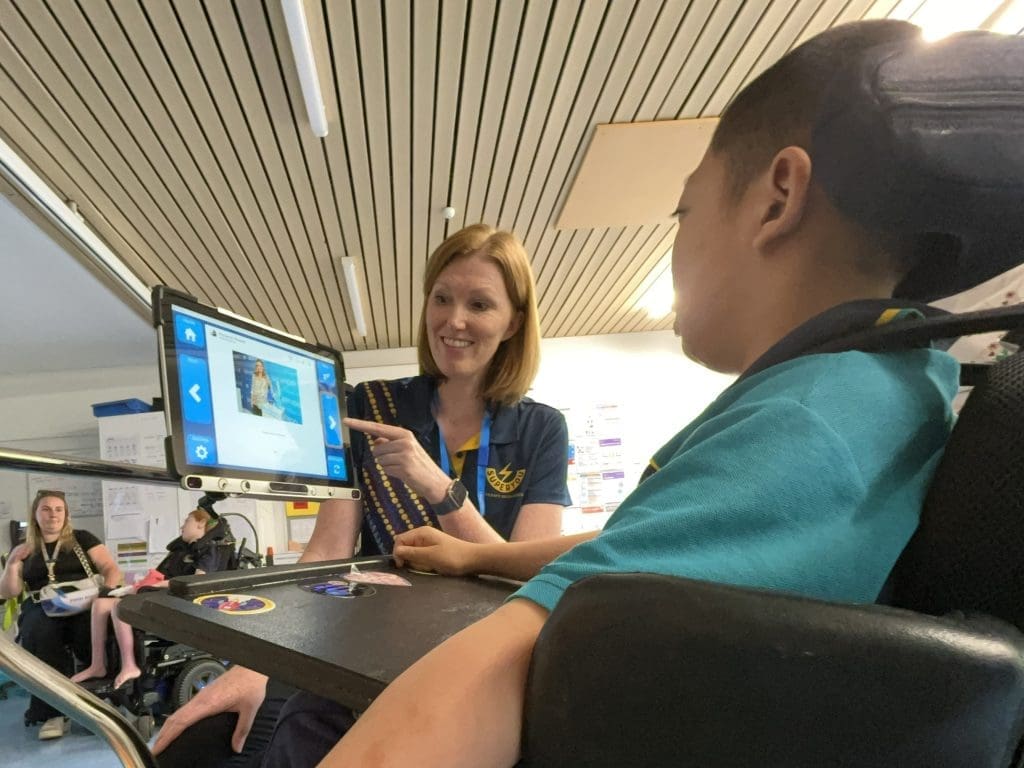
Our primary focus is on supporting schools, including Education Support Schools and Centres, education support units, and mainstream primary and secondary schools. We work alongside educators, inclusion teams, and leadership to integrate augmentative and alternative communication (AAC) and access technologies, such as eye gaze and switch access, into everyday classroom practice. Where appropriate, this support also extends to early learning centres, kindergartens, and daycares to support continuity across education environments.
Our focus is on building educator capability and creating sustainable systems that support participation, independence, and access to learning and the curriculum.
Who the ACE Service Is For
The ACE Service is designed primarily for school settings supporting students with complex communication and physical access needs. We also support early learning environments where children require similar access and communication supports.
This includes:
- Education Support Schools and Education Support Centres
- Mainstream primary and secondary schools
- Specialist programs and inclusion units
- Education networks and regional teams
- Daycares, early learning centres, and kindergartens
Educators, education assistants, therapists, and leadership teams
Why the ACE Service Exists
Many students benefit from AAC and access technologies, yet these supports are not always embedded successfully into everyday classroom routines.
While individual therapy recommendations may identify what a student needs, they do not always translate into practical, consistent use within busy school environments. Educators are often required to balance curriculum delivery, whole‑class responsibilities, and diverse student needs, without the time, training, or systems needed to confidently implement AAC and access technologies as part of daily practice.
The ACE Service exists to bridge this gap.
Rather than focusing solely on individual recommendations, the ACE Service centres on how communication and access supports function within real school settings. We work with education teams to move from isolated strategies to consistent, whole‑team practice that aligns with curriculum demands, school systems, and setting priorities. Where support is provided in early learning environments, this approach is adapted to align with early learning frameworks and routines.
The ACE Service does not replace students’ individual NDIS‑funded therapy supports. Instead, it works alongside existing recommendations to support schools in integrating communication and access strategies into classroom routines, systems, and team practice, creating sustainable approaches that support participation, independence, and access to learning over time.
What the ACE Service Offers
School and Centre Based Capacity Building
Support is delivered within real classrooms and learning environments and tailored to your setting’s priorities, student cohort, and staff capability goals.
AAC and Access Technology Implementation
We support education teams to implement and use:
- AAC systems
- Eye gaze technology
- Switch access
- Alternative access methods
with a strong focus on functional use within everyday classroom activities, routines, and learning contexts. This approach can be adapted for play based learning in early learning settings where required.
Collaborative Coaching and Support for Educators
Our clinicians work alongside educators through modelling, coaching, and problem solving, supporting confidence and consistency across teams.
Flexible Service Models for Schools
The ACE Service can be delivered through:
- Short term consultation
- Targeted classroom or room based support
- Ongoing onsite or scheduled engagement
Service models are co designed to align with curriculum requirements, staffing structures, and student needs. Early learning frameworks are considered when services are delivered in early childhood settings. Service intensity is guided by your school’s priorities, existing systems, and staff confidence, and may change over time as capacity builds, ensuring support remains practical and sustainable.
Examples of ACE Service support include:
• Supporting a classroom team to embed AAC use during literacy blocks
• Coaching education assistants to confidently implement switch access routines
• Working with leadership to establish consistent AAC systems across year levels
What Makes the ACE Service Different
Specialist Expertise in AAC and Access
The ACE Service is delivered by experienced allied health clinicians, including speech pathologists and occupational therapists, with specialist expertise in AAC and access technologies in education settings.
Partnership Driven Approach
We work in partnership with:
- Education Support Schools and Centres
- Mainstream schools
- Education networks
- Early learning centres and kindergartens
to ensure supports align with existing systems, routines, and priorities.
Focus on Sustainable School Practice
The ACE Service prioritises:
- Educator capability
- Embedded routines and frameworks
- Long term impact beyond individual students
Benefits of the ACE Service
Benefits for School and Education Teams
- A cohesive, whole school approach to supporting students with complex needs
- Increased staff confidence using AAC and access technologies
- Practical professional learning embedded into daily classroom practice
- Reduced time burden through tailored, in context support
Benefits for Students
- Greater participation in learning
- Increased independence using assistive technology
- Improved access to communication and the curriculum
- A more inclusive and responsive education environment
Let’s Reimagine Partnership
By reimagining what partnership looks like, Superyou Therapy helps schools move from compliance to connection—empowering educators, students, and families to thrive together.
Frequently Asked Questions
Who delivers the ACE Service?
The ACE Service is delivered by experienced allied health clinicians with specialist expertise in AAC, access technologies, and school-based practice. We work alongside education teams in real learning environments to support confident, consistent implementation.
Is the ACE Service individual therapy?
No. The ACE Service is a capacity-building, education-focused service. While individual student needs inform the work, our primary focus is strengthening educator capability, classroom routines, and school systems so communication and access supports are used consistently across the setting.
Can the ACE Service work alongside NDIS-funded therapy supports?
Yes. The ACE Service is designed to complement, not replace, individual therapy supports. Where a student has existing recommendations, we help education teams translate them into practical classroom routines and whole-team practice, aligned with school priorities and everyday curriculum delivery.
What does ACE support look like in practice?
Support is tailored, but commonly includes in-class modelling, coaching, and collaborative problem solving. For example, we may support teams to:
- embed AAC use within daily learning routines
- establish consistent access methods (e.g. switch access) across staff
- strengthen classroom systems so students can participate more independently
What technologies and systems can you support?
We support implementation of AAC systems and access technologies such as:
- communication boards, books, apps, and speech-generating devices
- eye gaze technology
- switch access
- alternative access methods as appropriate
Our focus is on functional use within real classroom activities and routines.
Which schools and settings is the ACE Service for?
The ACE Service is designed primarily for schools supporting students with complex communication and physical access needs, including Education Support Schools and Centres, mainstream primary and secondary schools, specialist programs, and inclusion units. Where appropriate, we can also support early learning centres and kindergartens to maintain continuity across learning environments.
How long do schools usually engage with the ACE Service?
Engagement can be short-term or ongoing, depending on your goals. Some schools begin with consultation to clarify priorities and next steps, while others choose targeted classroom support or scheduled engagement over time. Service intensity can change as staff confidence and systems strengthen.
Do we need NDIS funding to access the ACE Service?
No. Schools and education providers can access the ACE Service directly. Where relevant, we can also work alongside existing funding pathways to support coordination and sustainability.
Can you support education assistants and inclusion teams?
Yes. We work with teachers, education assistants, inclusion staff, and leadership teams to build consistent practice across everyone supporting the student. Coaching and modelling are designed to be practical, achievable, and aligned with classroom realities.
How do schools get started with the ACE Service?
Most schools start with a conversation about priorities—what’s working, what’s challenging, and what the team wants to strengthen. From there, we recommend the most suitable approach and co-design a model that fits the setting.